

March 2026 | Germany | Climate change

© lamyai | iStock
How Does Temperature Influence Occupational and Commuting Accidents in Germany?
What is the relationship between climate change and workplace accidents? This article examines the relationship between extreme temperatures and workplace accidents in Germany.
Climate change is not just an abstract future scenario: Its effects are already being felt in many aspects of our everyday lives. In its sixth report (published in 2021), the Intergovernmental Panel on Climate Change (IPCC) reports an increase in the global temperature of around one degree compared to pre-industrial levels. According to data from the EU Earth Observation Service Copernicus, 2024 was the first year in which the 1.5-degree threshold was surpassed.
Germany’s National Meteorological Service, the Deutscher Wetterdienst (DWD) estimates that the average air temperature in Germany increased by 1.9 degrees Celsius between 1881 and 2024, which is significantly higher than the global average of around 1.55 degrees Celsius. A large proportion of this increase has occurred in the last two decades. According to weather records, the number of ‘hot days’ with temperatures of at least 30°C has roughly tripled since the 1950s. Conversely, the number of frost days, when the temperature does not rise above 0°C, has decreased significantly. This temperature increase, which has already occurred and is expected to continue, requires adjustments in all areas of life.
Social accident insurance must also adapt to new challenges. The Robert Koch Institute (RKI), the German Federal Government’s central institution in the field of biomedicine, estimates that there were around 3,000 excess deaths related to heat in both 2023 and 2024. Therefore, protecting employees from such health hazards is becoming an increasingly important part of prevention work. However, the incidence of accidents will also change as temperatures rise. It is hardly surprising that more accidents occur on frosty days with snow and black ice on the way to work or on company premises. A decrease in the number of frosty days could lead to fewer accidents. Nevertheless, little attention has been given to the fact that high temperatures can impair concentration and reduce reaction times, thereby increasing the risk of accidents.
K. Drescher and B. Janzen in their article “When weather wounds workers: The impact of temperature on workplace accidents”, published in the Journal of Public Economics, recently presented an analysis of the temperature dependence of workplace accidents in Switzerland. Using data from 1996 to 2019, they found increased risks at both very low and very high temperatures. We adapted the methodology to investigate accidents in Germany and found very similar results. Additionally, data from the German Social Accident Insurance System can be used to examine commuting accidents, distinguishing between those that occurred in road traffic and those that did not.
Influence of temperature on all accidents | © DGUV
Our analysis is based on accident data from the DGUV and weather data from the DWD for the years 2017 to 2023 at postcode level (five digits).
The weather data consists of daily measurements of maximum temperature, average temperature, total precipitation and average relative humidity from numerious measuring stations. The DWD remapped them to postcode level using a conservative remapping method.
The DGUV’s overall statistics dataset contains an annual sample of reportable accidents delivered by social accident insurance institutions. As the postcode of the accident location has only been recorded since 2017, daily accident data for the period from 2017 to 2023 is used. The following section examines the extrapolated number of accidents per day and postcode area for employees, with separate analyses for different types of accidents.
Temperature is coded in the form of indicators for a range of temperature bands, each five degrees wide, for the daily maximum temperature. This enables the impact of temperature on the number of accidents to be estimated without defining a specific functional relationship. A Poisson model is used to estimate these effects (Poisson models are used to analyse countable dependent variables, such as accident numbers). Postcode areas naturally vary in terms of the number of employees, and therefore in terms of the expected number of accidents. However, due to the panel data structure, a fixed effects approach can be employed, whereby deviations from the regional and seasonal means are considered rather than absolute values.
To include regional differences and seasonal changes, indicators are used on a postcode-area-week basis. Larger-scale influences and different regional developments are controlled for via fixed federal state-year-month effects. Furthermore, different days of the week, as well as public and bank holidays, are considered at the federal state level.
The coefficients determined for the temperature indicators show the difference in accident figures between the respective temperature interval and the base temperature range (ten degrees Celsius to < 15 degrees Celsius) and can be converted into a percentage effect.
Influence of temperature on occupational accidents and commuting accidents | © DGUV
Results
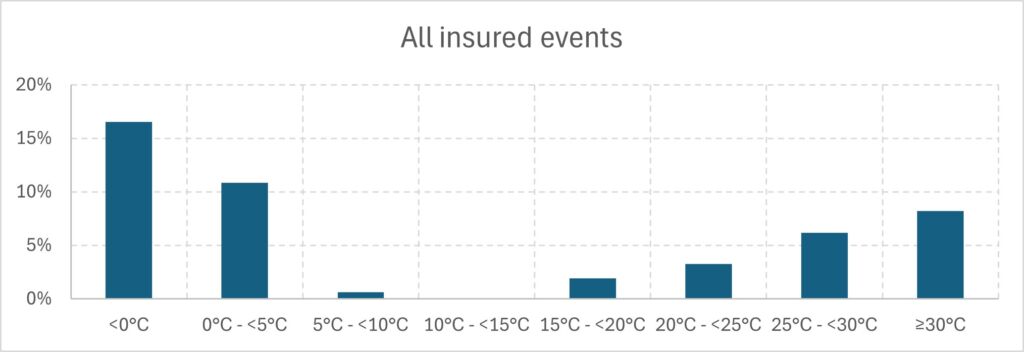
First, we examine all accidents involving employees. The typical U-shaped curve of the temperature effects is clearly visible: Both very low and very high temperatures lead to more accidents than moderate temperatures do.
The effects of temperatures below freezing are significantly greater in magnitude. While temperatures above 30 degrees Celsius result in an average increase of about eight per cent in the number of accidents compared to the base temperature, the number of accidents at negative temperatures is actually about 16 per cent higher. However, an increase in temperature does not necessarily lead to a reduction in accidents overall, as the rise in hot days has so far been much greater than the fall in frost days.
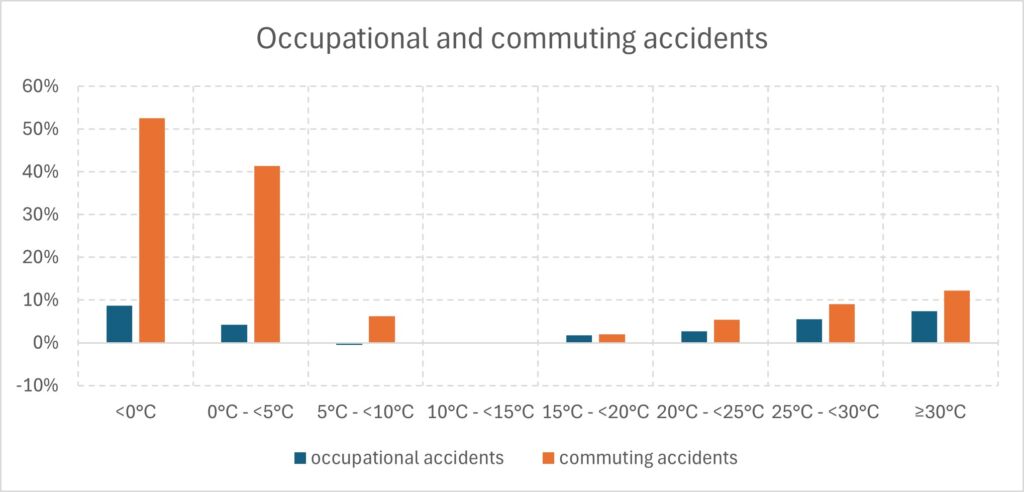
In the second step, we examine work-related and commuting accidents separately. The data shows that the number of commuting accidents in particular increases significantly due to frosty temperatures. These are most likely to be typical tripping, slipping and falling accidents due to slippery roads and pavements. Nevertheless, there are approximately 12% more commuting accidents on hot days than on days with baseline temperatures.
Focusing on accidents at work alone reveals an almost symmetrical U-shaped trend. High temperatures therefore have a similar effect on accident figures to that of very low temperatures. Compared to the results of Drescher and Janzen for workplace accidents in Switzerland, the temperature effects in Germany are almost identical.
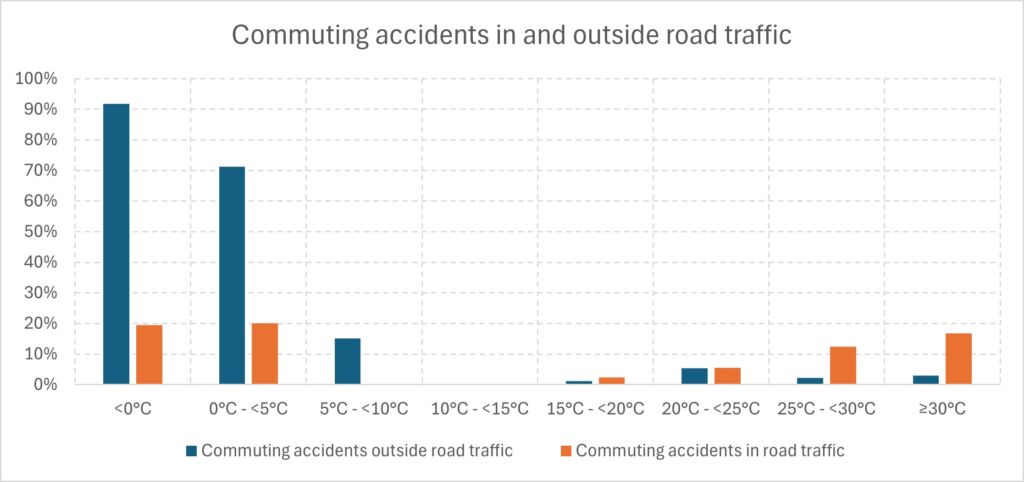
Subdividing commuting accidents further into road traffic and non-road traffic accidents is very revealing.
While accidents outside of road traffic almost double at very low temperatures (approximately + 92%), very high temperatures have virtually no effect. By contrast, commuting accidents involving road traffic show similar effects at very low (approximately +20 per cent at below 0 degrees Celsius) and very high (approximately +17 per cent at 30 degrees Celsius or above) temperatures.
Influence of temperature on commuting accidents in and outside road traffic | © DGUV
Summary and outlook
The rise in temperatures in Germany associated with climate change affects all areas of life. German social accident insurance must adapt to these new challenges in preventing work-related health hazards. The DGUV’s accident data, when combined with weather data from the DWD, can support the targeted and evidence-based work of accident insurance institutions. By analysing typical accident scenarios in different temperature ranges, it can provide important information for prevention purposes. ●