

September 2026 | Poland | Mental Health
© KRUS 2026
It Takes a Village to Save a Farmer’s Life: farmers’ mental health as a field of action for a social insurance institution
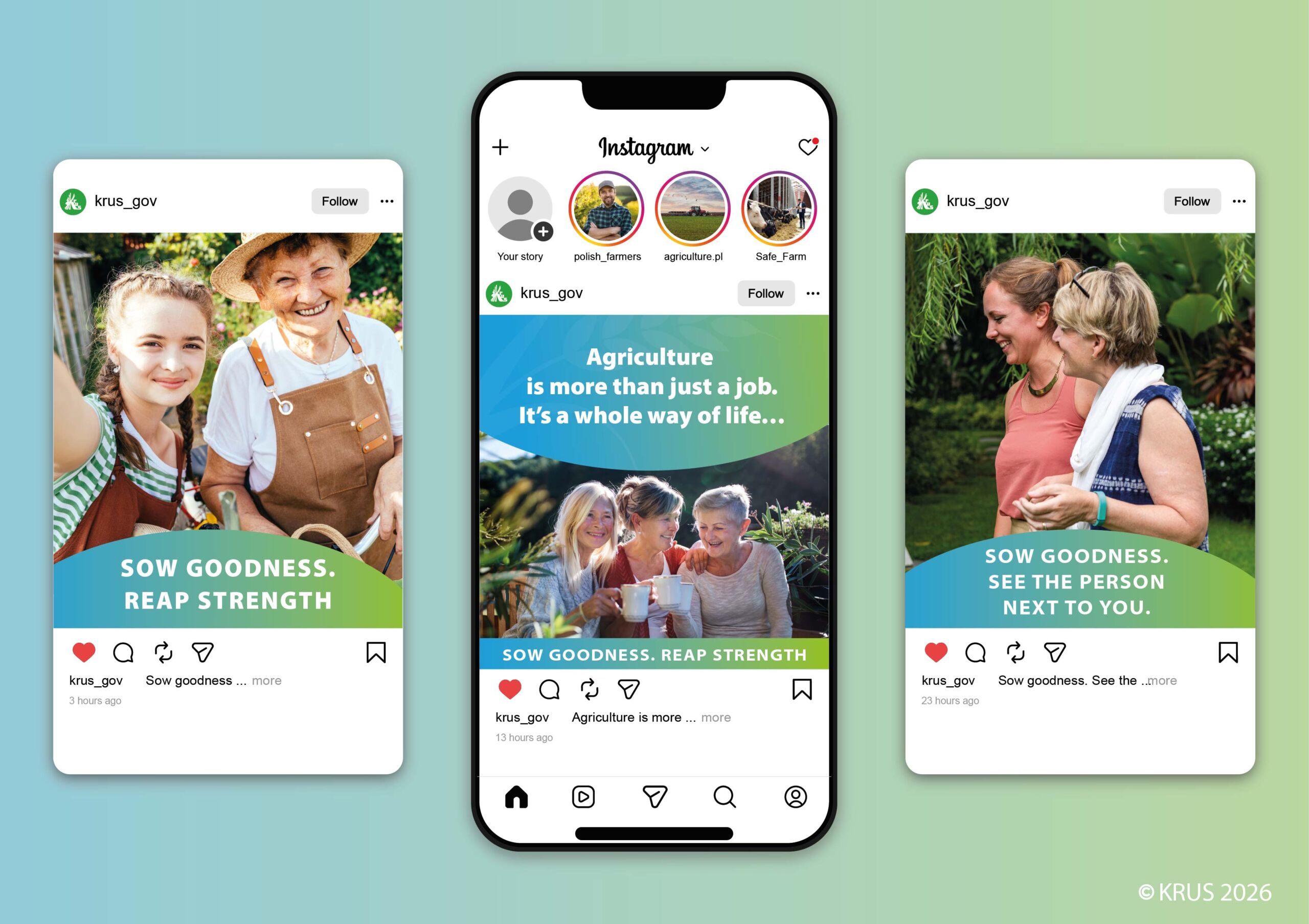
The Farmers’ Social Insurance Act obliges the Agricultural Social Insurance Fund (KRUS) to prevent accidents at farm work and agricultural occupational diseases, listing analysis of their causes, training in health and life protection on the farm, dissemination of knowledge about hazards, and efforts to secure safe equipment and protective clothing1. These provisions are deliberately general: a statute must cover an institution’s activities across decades without frequent amendment. This generality lets the mandate be filled with the content each new decade brings. In the Fund’s practice, accident prevention includes informing about psychosocial risks and the farmer’s psychophysical condition2. This direction was reinforced by Vision Zero, which the Fund joined in 2018 as an official partner, basing prevention on three pillars: safety, health, wellbeing3. And yet, despite ever more advanced machinery and systems for monitoring crops and livestock, the risk of suicide among farmers in Europe remains higher than in other occupational groups. KRUS decided to address this by adding to its preventive activities a programme built on human, neighbourly support: “Sow goodness. Reap strength”.
The empirical grounds are clear. A meta-analysis of studies from over a dozen countries found an elevated risk of death by suicide among those employed in agriculture, forestry and fishing4. French data indicate a suicide rate among farmers roughly 20% above the national average, the highest risk falling on men aged 45–545. EU-OSHA documents that half of EU farmers and farm workers regularly exceed 48 working hours per week, operating in isolation and under a regime of constant availability6. Irish research found no significant difference from the rest of the population7 — making a national diagnosis all the more necessary.
Poland has no such diagnosis. The EZOP II study indicates that over a quarter of the country’s adults experience a mental disorder at some point in their lives8, yet there is no representative study of the farming population and no analysis of suicide deaths accounting for occupational status. What we do have is a study of the social wellbeing of Polish women farmers: 42% report a lack of understanding and emotional support from those closest to them, 22% a sense of loneliness, only 37% a sense of calm and inner harmony — against 65% declaring general life satisfaction9. The distribution is telling: rural women report a deficit of closeness more often than loneliness — living surrounded by family without experiencing its emotional availability. An infrastructural barrier compounds this: three health centres per 10,000 rural inhabitants against nearly 6.5 in towns10.
The risk profile here departs from the typical employee profile in three respects. First, the absence of control: the outcome of work depends on weather, purchase prices and production costs, and effort does not translate predictably into result. Second, the inseparability of roles — the farm is at once workplace, family property, home and generational inheritance, so economic failure becomes a biographical rather than an occupational defeat. Third, isolation combined with visibility: the farmer is alone in action, yet observed in failure by a small community with a high degree of social control. Research on masculine identity in farming shows that self-reliance as a norm inhibits help-seeking11. This is a cultural barrier, not an informational one, and calls for an instrument other than health education.
The gender dimension is decisive. A report based on National Police Headquarters data shows that men in Poland take their own lives five times more often than women: of roughly thirteen suicide deaths a day, eleven are men12. The cultural script under which men do not signal helplessness translates directly into mortality statistics13. Several initiatives addressed exclusively to men already operate in Poland — the Masculinum Foundation, the New Community Foundation, the “Panowie, gadamy” (“Gentlemen, let’s talk”) project, the Men’s Congress, the Conscious Man festival. None is directed at farmers, although it is here that norms of masculinity intertwine most tightly with occupational isolation. Investigating this remains an urgent task for Polish suicidology.
The design of “Sow goodness. Reap strength” follows from this. The point of entry is not a diagnosis but a neighbourly relationship, and the core of the message is one question — “How are you doing?” — addressed to a neighbour, a family member, an acquaintance. We make the person’s surroundings, rather than the person in crisis, the addressee of the intervention. We draw on research into anti-stigma programmes, where social contact reduces social distance and discriminatory intentions towards people with mental health problems14, and on the evaluation of England’s Time to Change, which confirmed a moderate but significant improvement in population attitudes15. The campaign has four stages: awareness, local communities, education, signposting to sources of help. Its four pillars are: notice, ask, listen, support.
The President of the Fund, Tomasz Ślusarczyk, put this intention as follows in the opening campaign material: “We are launching the «Sow goodness. Reap strength» campaign to build together a culture of mutual care and support. Let us notice one another. One gesture, one word, one conversation really can change a great deal. We heal by speaking”16. The campaign’s expert partner, rural sociologist Professor Wojciech Knieć of Nicolaus Copernicus University in Toruń, pointed there to social capital — neighbours, family, friends — as the resource determining a long and happy life, while reminding viewers that support is also offered by institutions present in rural surroundings17.
The second and third stages consist of 49 meetings for Rural Housewives’ Circles, held at the initiative of the Ministry of Agriculture and Rural Development with the agricultural advisory centres. The choice of channel is deliberate: a Housewives’ Circle is not a venue into which a health message is carried — it is itself a grassroots structure of support, free of stigma. This matches the European recommendation to strengthen trusted intermediaries as the first link in early recognition18.
Intellectual honesty requires that the limitations be stated. Without a baseline measurement, the campaign’s effect can be shown only through reach indicators, which are not a measure of health outcomes; what is needed is research permitting international comparison — its scarcity in Central and Eastern Europe has been identified explicitly as a gap18. Psychosocial risk moreover has no separate heading in reporting, complicating the planning of expenditure over a longer horizon. Finally, an awareness campaign cannot substitute for the availability of services: greater readiness to seek help, without a matching increase in the supply of care, creates a risk of institutional disappointment — a real one, given the documented infrastructure deficit in rural areas.
Three comparative observations suggest themselves. The generality of a statutory mandate is an asset rather than a gap: it lets the scope of prevention develop without legislative amendment, and action taken on that basis is received as care rather than as the discharge of a reporting obligation. Activating existing community structures — which a social insurance institution does not manage but can reach — proves more effective than a clinical message. Finally, psychosocial prevention requires a research infrastructure slower to build than the campaign itself — and it ought to precede it. We would welcome contact with member institutions running comparable programmes, particularly on methodology and evaluation. ●