

September 2026 | Poland | Conference Review
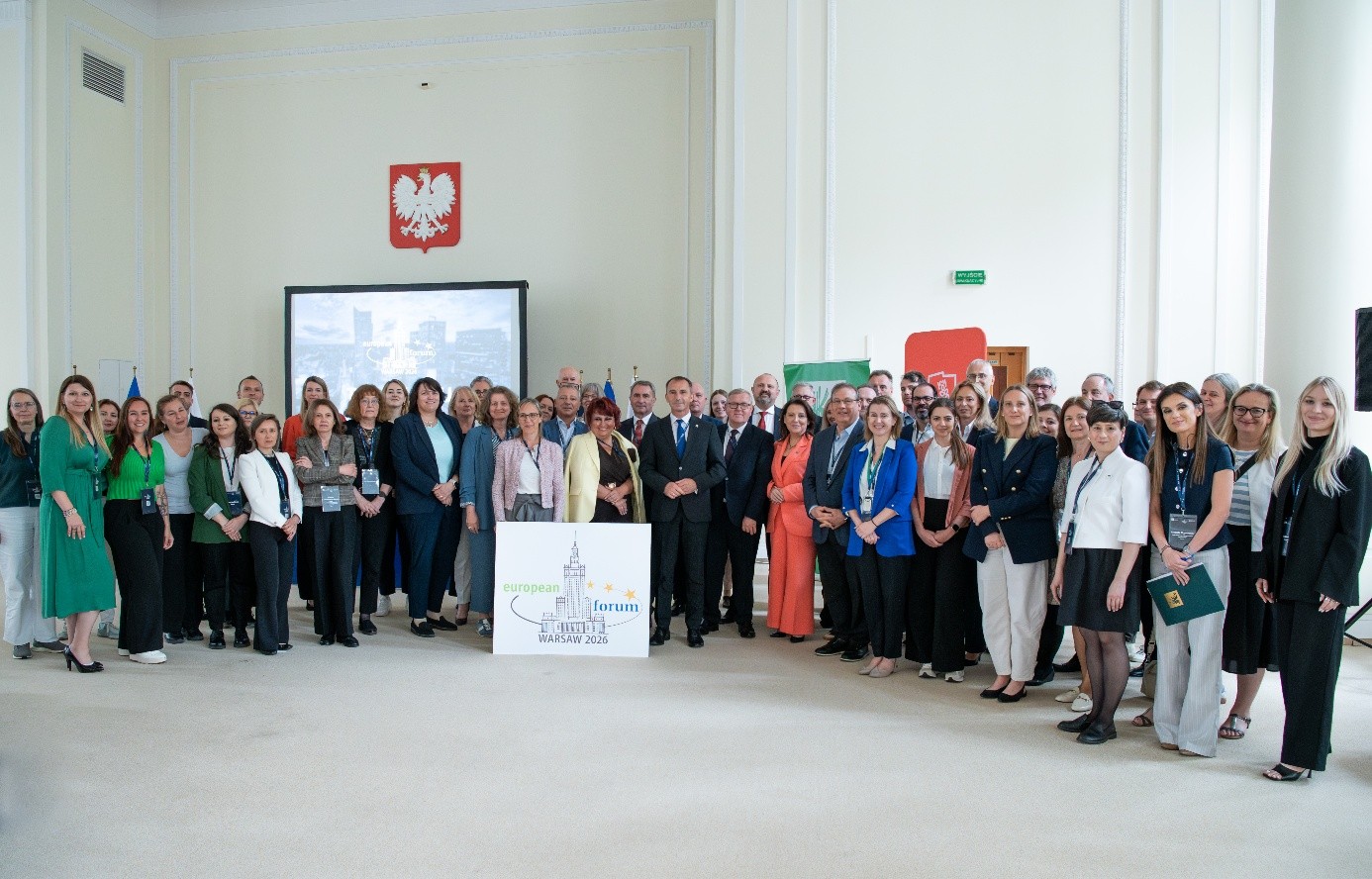
© KRUS
Conference Review: Poland 2026
From June 17 to 19, Agricultural Social Insurance Fund (KRUS) in Warsaw (Poland) hosted the 34th European Forum of the Insurance against Accidents at Work and Occupational Diseases conference combined with Working Group meetings and Plenary Assembly. Under the theme «Be Well: Keeping Up Physical and Mental Health», members of the European Forum and invited guests gathered to explore how we can maintain physical and mental health in a changing world of work.
The first day was dedicated to the meetings of the European Forum’s Working Groups on communication, legislation, digitalisation, occupational diseases and prevention, held at the Agricultural Social Insurance Fund (KRUS) headquarters. The day concluded with a welcome event at the Kameralna restaurant, where our guests enjoyed traditional Polish food while networking informally and exchanging ideas ahead of the main conference.
The second day, held at the National Health Fund headquarters, featured a full conference programme. The conference opened with a welcome speech by Mr Tomasz Ślusarczyk, KRUS President, and a reading of official letters from Poland’s Minister of Family, Labour and Social Policy, Mrs. Agnieszka Dziemianowicz-Bąk, and from Poland’s Minister of Agriculture and Rural Development, Mr Stefan Krajewski, both underlining the importance of preventing occupational accidents and diseases and the European Union’s objective of ensuring and creating conditions in which every worker in the EU enjoys fundamental rights relating to health and safety at work. The welcome speech was followed by an introductory speech on well-being in the age of AI by Mr Greg Margas who showed how to maintain well-being in a digital world through connection to nature, our inner self, and focusing on one purpose while working.
After the introductory speech on well-being, Ms Ana Ercoreca de la Cruz, Labour and Social Security Inspector and Secretary – General of the International Association of Labour Inspectors (IALI), talked about the mental health and the use of AI and its impact on the Labour Law and the role of labour inspectors to ensure the rights of workers. Subsequently, the speakers from various industry sectors presented practical solutions for workers to maintain their safety and well-being at work. As KRUS is an institution devoted to social insurance for rural community, a special focus was given to solutions in agriculture.
Mr Phillip Germain, President of the International Association of Industrial Accidents Boards and Commissions (IAIABC), and Second Vice-Chair of the Association of Workers’ Compensation Boards of Canada (AWCBC), and Chief Executive Officer of the Saskatchewan Workers’ Compensation Board (WCB) and Ms Heather Lore, Executive Director of the International Association of Industrial Accident Boards and Commissions (IAIABC) presented the topic of injury prevention and workers compensation in Canada and the United States with the focus on industry. Mr Cezary Nobis, Director of Prevention Office at KRUS, introduced the KRUS prevention campaign “Farmer’s Well-being” on how to take care of physical, mental and social health to prevent accidents at work targeted at farmers and rural inhabitants. Ms Païvi Wallin, Director and a Member of the Management Team at the Farmers’ Social Insurance Institution Mela of Finland, presented workability services for farmers offered by Mela that help farmers monitor, protect, and improve their occupational well-being and safety.
The afternoon session began with Ms Belén Revelles from SOCIEUX+ EU Expertise on Social Protection, Labour and Employment, who showed how occupational safety and health systems can be strengthened through peer-to-peer cooperation. Afterwords, Mr Daniel Zahorenko, Chief Executive Officer of the Polish AGRO Insurance – Mutual Insurance Company (AGRO Ubezpieczenia – TUW) shared how risk management of business activity enhances the occupational well-being of farmers by securing their livelihoods and indirectly prevents mental health illnesses that can even result in suicide. Then, Ms Miriam Stuckert from the International Section of the ISSA on Prevention of Occupational Risks in Health Services, talked about a phenomenon of workplace violence in the health care services and how the Vision Zero strategy can help to tackle this issue which impacts safety, health and well-being of workers in the health care sector. The issue of violence at the workplace, but from a very interesting perspective – when violence is a result of a terrorist attack, was presented by Mr Michael Maltrovsky from the Austrian General Accident Insurance Institution AUVA who discussed possibilities of an accident insurance carrier to keep up mental health of workers and participants of a terrorist attack. Finally, the afternoon session was concluded by a lecture on obesity as a growing health problem in the work environment impacting occupational safety, health and well-being presented by Ms Elżbieta Łastowiecka-Moras, MD-PhD, a researcher from the Central Institute for Labour Protection – National Research Institute CIOP-PIB of Poland.
The day ended with a gala dinner at DOCK19 restaurant by Mateusz Gessler in a vibrant post-industrial setting of old Power Station Powiśle. The third and final day was devoted to the European Forum’s Plenary Assembly, during which members shared updates and news from their countries/institutions, and voted on decisions for the future of the European Forum such as, among other things, the change of the official name of the European Forum.
The conference in Warsaw reaffirmed the European Forum’s role as a platform for cooperation and knowledge exchange. The conference showed that the modern approach to well-being extends beyond the traditional understanding of occupational health and safety. Issues related to mental health, psychosocial risks, managing chronic health conditions, work organization, and the impact of technological changes on employees’ daily functioning are gaining increasing importance and strategies mitigating these risks and negative impacts should be introduced by employers. In this context, the role of insurance institutions as those directing attention of employers to these risks and showing possible pathways to better protect employees remains significant and relevant.
The 35th European Forum conference will be held in 2027 in Paris, France. ●